Before Lindsay Clancy: The Constance Fisher Case and the Devastating Reality of Postpartum Psychosis. Part 1 of 2
CONTENT WARNING: This article and podcast discusses the deaths of children, suicide attempts, severe mental illness, postpartum psychosis, hallucinations, and filicide. Reader discretion is advised.
Nearly seventy years separate the cases of Constance Fisher and Lindsay Clancy.
One unfolded in mid-century Maine, when psychiatric hospitals were still referred to as asylums and doctors were only beginning to understand severe mental illness following childbirth.
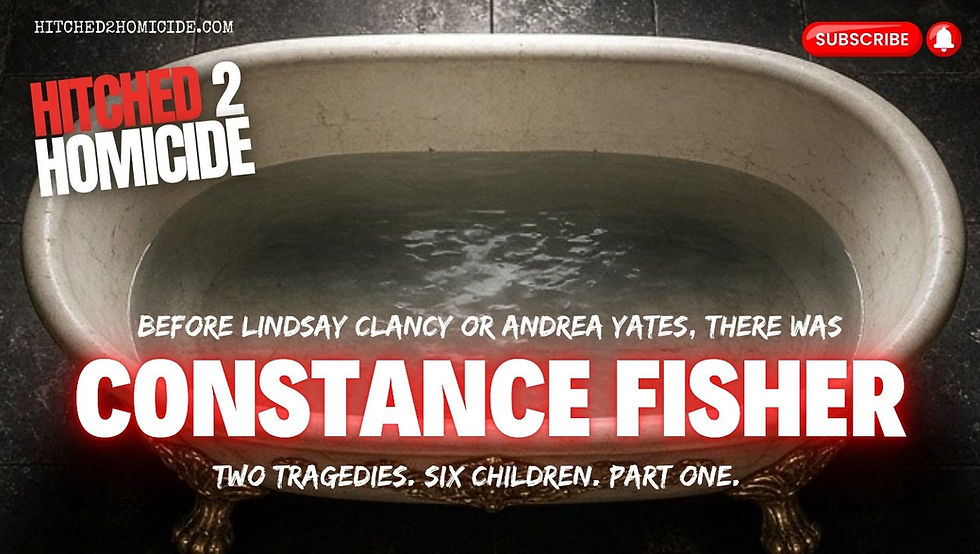
Nearly seventy years separate Constance Fisher and Lindsay Clancy, but both cases force the same question: what happens when motherhood collides with psychosis?
The other unfolded in modern Massachusetts, in an era of antidepressants, psychiatric tragedies medications, inpatient treatment, electronic medical records, maternal mental-health screening—and considerably more knowledge about postpartum psychiatric disorders.
Yet the two cases raise hauntingly similar questions.
What happens when a mother loses touch with reality?
How do doctors distinguish postpartum depression from something far more dangerous?
When does mental illness become so severe that a person can no longer understand what she is doing?
And, perhaps most importantly, how do we recognize the warning signs before a family is destroyed?
For Constance Fisher, those questions came too late. Not once. But twice.
Six children died twelve years apart.
Their names were Richard, Daniel, Deborah, Kathleen, Michael, and Natalie Fisher.
And decades later, when Lindsay Clancy was accused of killing her three children—Cora, Dawson, and Callan Clancy—the Fisher case suddenly felt disturbingly relevant again.
Constance Fisher: A Maine Family in 1954
Constance Margaret Sirois Fisher was born in Maine in 1929 and married Carl Fisher.
By 1954, Constance and Carl were living in Waterville, Maine, with their three young children:
Richard Fisher, 6 Daniel Fisher, 4 Deborah Fisher, 11 months.
On March 8, 1954, all three children died after being drowned in the family's home. Contemporary newspaper reporting documented the deaths and Fisher's subsequent arrest and psychiatric proceedings.
Constance survived an attempt to end her own life.
From the beginning, the case was treated differently from an ordinary homicide prosecution because questions arose immediately about Fisher's mental state.
Historical accounts of her psychiatric condition are not completely consistent, and that distinction matters.
Over the course of her life, Fisher was described under several different psychiatric diagnoses, including paranoid schizophrenia and postpartum psychosis. Other descriptions of her condition changed as psychiatric thinking itself evolved. It would therefore be inaccurate to retroactively say with certainty that doctors in 1954 understood her illness in precisely the same terms doctors use to diagnose postpartum psychosis today.
What was clear was that professionals considered her profoundly mentally ill.
She was ultimately committed to Augusta State Hospital, rather than being incarcerated as a conventional convicted murderer.
Augusta State Hospital
The institution that received Constance Fisher was part of a psychiatric system dramatically different from the one that exists today.
Large state hospitals housed thousands of Americans with serious psychiatric illnesses. Treatments were evolving rapidly, sometimes painfully, and understanding of conditions connected specifically to pregnancy and childbirth remained primitive by today's standards.
Fisher remained institutionalized for several years.
Her husband, Carl, sought her release. According to accounts of the case, those efforts were initially rejected.
Eventually, however, Fisher's condition appeared to improve.
On March 6, 1959, roughly five years after the deaths of Richard, Daniel, and Deborah, Constance Fisher was released from Augusta State Hospital and returned to her husband's custody.
It was supposed to represent recovery.
Carl and Constance attempted to rebuild their lives. They moved to Fairfield, Maine and they had three more children: Kathleen Louise born in 1960, Michael Jon in 1962, a nd
a daughter Natalie Rose, born in 1965.
For several years, the nightmare of 1954 appeared to be over.
It wasn't.
June 30, 1966
Twelve years after Richard, Daniel, and Deborah died, Carl Fisher came home on June 30, 1966.
Inside the house was another catastrophe. Nine-month-old Natalie was found drowned.
Police would also find Michael, 4, and Kathleen, 6, dead inside the home also from drowning.
Constance was alive but unconscious following another suicide attempt involving an overdose of pills.
Contemporary newspapers immediately recognized the almost unfathomable similarity between the two events. One newspaper described what had happened as a "duplication of tragedy."
Three children. Then, twelve years later, three more. Even their ages were strikingly similar. Richard had been six. Daniel had been four. Deborah had been eleven months old. Kathleen was six. Michael was four. Natalie was nine months old.
Six children from the same family had died.
The Second Psychiatric Case
Constance survived.
She was initially hospitalized medically and then entered the legal system again.
Unlike the first case, prosecutors moved toward murder charges and questions about whether Fisher was competent to stand trial.
A psychiatric evaluation followed.
The crucial distinction was—and remains—one of the most difficult questions criminal courts encounter: Was Constance Fisher mentally ill, or was she so mentally ill that she could not legally be held criminally responsible for what she had done?
Those are not the same thing.
A person can have a serious psychiatric disorder and still meet the legal definition of criminal responsibility.
Ultimately, Fisher was again found not criminally responsible because of mental illness and returned to Augusta State Hospital. Contemporary reporting from January 1967 documented the competency and insanity proceedings that followed the second deaths.
This time, she would not return home.
Constance Fisher's Death
Constance remained institutionalized. On October 1, 1973, she left the grounds of Augusta State Hospital without authorization.
A search followed and days later, hunters discovered a woman's body in the Kennebec River near Gardiner, Maine. It was Constance Fisher.
Authorities concluded that she had drowned. Contemporary reports described the death as accidental, although the circumstances inevitably raised questions because of her psychiatric history and previous suicide attempts.
Constance was 44 years old.
The story of the Fisher family had begun with three dead children in 1954. By the time it ended, six children and their mother were dead. And the question that followed the case for decades was unavoidable: How could someone who had already killed three of her children ever have been released into circumstances where it could happen again?
Nearly 70 Years Later: Lindsay Clancy
On January 24, 2023, another Massachusetts family was shattered.
Lindsay Clancy was a labor-and-delivery nurse living with her husband Patrick and their three children in Duxbury, Massachusetts.
Their children were: Cora Clancy, 5 Dawson Clancy, 3 Callan Clancy, 8 months.
Months before the children's deaths, Lindsay had been seeking mental-health treatment.
Records and arguments later presented in court showed that she had struggled with anxiety, depression, suicidal thoughts, intrusive thoughts, medication changes, and concerns about her ability to cope.
On January 1, 2023, she voluntarily entered McLean Hospital for psychiatric treatment.
She was discharged several days later. Contemporary reporting indicated that she was not considered an imminent danger to herself or others when she left the hospital.
Nineteen days later, all three Clancy children would be dead.
January 24, 2023
On the morning of January 24, Lindsay took Cora to a doctor's appointment.
Later, she played outside in the snow with the children and sent photographs to family members.
That evening, Patrick Clancy left the house to run an errand and pick up dinner.
While he was gone, Lindsay strangled all three children with exercise resistance bands.
Cora and Dawson were pronounced dead that evening.
Eight-month-old Callan initially survived and was flown to Boston Children's Hospital, but he later died.
After harming the children, Lindsay attempted to take her own life by jumping from a window.
She survived but suffered severe spinal injuries that left her paralyzed.
Patrick returned home and discovered his wife seriously injured outside. When he asked where the children were, she told him they were in the basement. What he found there became one of the most agonizing pieces of evidence presented in the case.
"A Moment of Psychosis"
In the weeks after the killings, Lindsay reportedly told Patrick that she had experienced what she described as a "moment of psychosis."
She said she had heard a male voice telling her to kill the children and herself.
That statement would become enormously important.
Her defense argued that Lindsay had been suffering from postpartum psychosis and therefore lacked criminal responsibility when she killed Cora, Dawson, and Callan.
Prosecutors challenged that interpretation.
They did not dispute that Lindsay had significant psychiatric problems. Their argument centered instead on whether she nevertheless knew what she was doing and understood that it was wrong.
The prosecution pointed to evidence it said demonstrated planning and purposeful behavior.
The defense pointed to months of psychiatric deterioration, medication changes, suicidal thinking, her hospital admission, expert psychiatric testimony, and the abrupt catastrophic behavior of a woman witnesses described as a loving and attentive mother.
That conflict eventually went before a jury.
The Lindsay Clancy Trial
Lindsay Clancy pleaded not guilty on the basis of lack of criminal responsibility.
Her 2026 trial lasted nearly six weeks where the fundamental question was not whether Lindsay killed her children. That was undisputed.
The question was whether the Commonwealth could prove beyond a reasonable doubt that she was criminally responsible for doing it.
Her defense maintained that she was experiencing postpartum psychosis.
Prosecution experts argued that, despite her mental illness, the available evidence showed that she remained capable of understanding her actions and their wrongfulness.
The jury could not agree.
On September 4, 2026, Judge William Sullivan declared a mistrial after seven days of deliberations and repeated reports that jurors were deadlocked.
Afterward, several jurors publicly said the split had been 11–1 in favor of finding Clancy not guilty by reason of lack of criminal responsibility. Because the verdict needed to be unanimous, no verdict was entered.
As of September 15, 2026, Lindsay Clancy has not been acquitted and has not been convicted.
Her attorney has asked the judge to enter a judgment of acquittal rather than require a second trial. A hearing is scheduled for September 29.
Constance Fisher and Lindsay Clancy: Where the Cases Intersect
It is tempting to look at these two cases and declare them the same.
They are not.
They occurred nearly seventy years apart. The women had different medical histories. Their treatments were different. The children's deaths occurred under different circumstances. The psychiatric evidence is different. And modern doctors should not retroactively impose today's diagnostic criteria onto Fisher's 1954 medical record.
But the parallels are impossible to ignore.
Both women were mothers of three young children. Both had documented histories of serious psychiatric disturbance. Both killed all three of their children. Both attempted suicide afterward.
Both cases centered on whether severe mental illness had destroyed the mother's ability to understand reality and appreciate the wrongfulness of her actions.
Both cases forced courts to confront an uncomfortable truth: Mental illness and criminal responsibility are related questions, but they are not identical questions.
And both cases demonstrate why severe psychiatric symptoms after childbirth cannot be dismissed as simply being overwhelmed, exhausted, anxious, or experiencing the "baby blues."
There is another difference that makes Fisher's case uniquely horrifying. Constance Fisher had already done it once. Three children were dead in 1954. She was hospitalized because of her mental illness. She was later considered well enough to return to the community.
She had three more children.
Then all three of those children died, too.
The second Fisher tragedy is therefore not simply a story about one woman.
It is also a story about risk assessment, psychiatric treatment, discharge planning, long-term monitoring, and the consequences of getting those decisions catastrophically wrong.
What Is Postpartum Psychosis?
Postpartum psychosis is not the same condition as postpartum depression.
It is rare, affecting approximately 1 to 3 mothers per 1,000 births, depending on the population and diagnostic criteria used.
It is also a psychiatric emergency.
Symptoms may include:
hallucinations—hearing, seeing, or perceiving things that are not there;
delusions or fixed beliefs that are not based in reality;
paranoia;
severe confusion;
disorganized thinking or behavior;
extreme agitation;
rapidly changing moods;
mania or unusually elevated energy;
profound depression;
severe insomnia or a dramatically decreased need for sleep; and
thoughts or beliefs involving suicide or harm to the baby.
The National Institute of Mental Health states that postpartum psychosis can involve hallucinations, delusions, mania, paranoia, and confusion and requires emergency treatment.
The American College of Obstetricians and Gynecologists likewise describes the condition as rare but serious and says it requires immediate psychiatric help, often including hospitalization.
But an equally important fact needs to be said clearly: Having postpartum psychosis does not mean a mother will harm her baby.
Postpartum Support International specifically notes that the majority of people who experience postpartum psychosis do not harm themselves or anyone else. The condition is treated as an emergency because impaired reality testing can create unpredictable and potentially severe risk.
That distinction matters.
Stories like Fisher and Clancy should increase awareness of postpartum psychosis—not increase stigma toward mothers experiencing it.
The Warning Signs Families Should Never Ignore
A mother does not have to say, "I have postpartum psychosis," for someone to recognize that something is terribly wrong.
In fact, a person experiencing psychosis may have little or no awareness that she is ill.
Families, partners, friends, and medical professionals should treat sudden postpartum symptoms such as hallucinations, bizarre beliefs, extreme paranoia, profound confusion, dramatic behavioral changes, inability to sleep, extreme agitation, or statements involving death, suicide, or harming a child as an emergency.
Do not assume she simply needs sleep.
Do not leave her alone to "calm down."
Do not leave her alone with the baby or other children if psychosis is suspected.
Postpartum Support International recommends staying with the parent and child while obtaining immediate professional help.
The Children at the Center of These Stories
True crime can sometimes allow the accused person to become the entire story.
That would be a mistake here.
Before there was a discussion about postpartum psychosis, insanity defenses, psychiatric hospitals, medications, expert witnesses, mistrials, or mental-health reform, there were nine children.
Richard Fisher.Daniel Fisher.Deborah Fisher.Kathleen Fisher.Michael Fisher.Natalie Fisher.
And nearly seventy years later:
Cora Clancy.Dawson Clancy.Callan Clancy.
Whatever conclusions people reach about the criminal responsibility of the women who killed them, the children deserve to remain at the center of their own stories.
They were not psychiatric case studies. They were not legal arguments. They were children.
Seventy Years of Progress—and the Question That Remains
Medicine knows vastly more about postpartum psychiatric illness today than doctors knew when Constance Fisher entered Augusta State Hospital in 1954.
We have diagnostic criteria, psychiatric medication, specialized perinatal psychiatrists, screening tools, and crisis lines.
We have decades of scientific research. And still, in 2023, Cora, Dawson, and Callan Clancy died after their mother had sought psychiatric help.
That does not mean the Fisher and Clancy cases prove the same institutional failure. The medical histories, diagnoses, evidence, and legal proceedings are substantially different.
But together they force us to ask a question that has followed the Fisher case for more than seventy years:
When a mother is telling us—through her words, her behavior, her symptoms, or her medical history—that something is terribly wrong, are we listening closely enough?
Because postpartum psychosis is rare. It is treatable. Recovery is possible.
But when psychosis is suspected, treatment cannot wait.
IF YOU OR A MOTHER YOU KNOW IS IN CRISIS
Postpartum psychosis is a medical and psychiatric emergency.
If a mother is hallucinating, experiencing delusions or severe confusion, talking about killing herself or her children, behaving bizarrely, or appears detached from reality, seek emergency help immediately.
If anyone is in immediate danger, call 911 or go to the nearest emergency room. The National Institute of Mental Health recommends immediate emergency evaluation for suspected postpartum psychosis.
National Maternal Mental Health Hotline
Call or text: 1-833-TLC-MAMA1-833-852-6262
Free, confidential support is available 24 hours a day, seven days a week for pregnant and postpartum mothers and families in the United States.
988 Suicide & Crisis Lifeline
Call or text: 988
Available 24/7 for anyone experiencing suicidal thoughts, a mental-health crisis, or concern about someone they love.
Postpartum Support International HelpLine
Call: 1-800-944-4773 Text in English: 800-944-4773Text in Spanish: 971-203-7773
The PSI HelpLine connects mothers and families with postpartum mental-health information, support, and resources. It is not an emergency line. For an immediate safety crisis, call 911 or 988.
Crisis Text Line
Text HOME to 741741
Free crisis support is available by text in the United States.
If you believe someone may be experiencing postpartum psychosis, stay with her and make sure the baby and other children are with a safe, responsible adult while emergency help is obtained. A formal diagnosis is not necessary before asking for help.
Help is available. Postpartum psychosis is treatable, and recovery is possible.
Sources used for this podcast:
1. Newspapers.com. (n.d.). Newspaper page image 854176794 [Digitized newspaper page]. https://www.newspapers.com/image/854176794/
Newspapers.com. (n.d.). Newspaper page image 854176737 [Digitized newspaper page]. https://www.newspapers.com/image/854176737/
Newspapers.com. (n.d.). Newspaper page image 854176810: Constance Fisher [Digitized newspaper page]. https://www.newspapers.com/image/854176810/
Newspapers.com. (n.d.). Search results for “Constance Fisher,” Maine, 1954. Retrieved September 15, 2026, from https://www.newspapers.com/search/results/?date=1954&keyword=Constance+Fisher®ion=us-me
Newspapers.com. (n.d.). Newspaper page image 848864685: Constance Fisher [Digitized newspaper page]. https://www.newspapers.com/image/848864685/
Newspapers.com. (n.d.). Newspaper page image 858194482 [Digitized newspaper page]. https://www.newspapers.com/image/858194482/
Newspapers.com. (n.d.). Newspaper page image 854940381 [Digitized newspaper page]. https://www.newspapers.com/image/854940381/
Newspapers.com. (n.d.). Newspaper page image 847904904: Constance Fisher [Digitized newspaper page]. https://www.newspapers.com/image/847904904/
Newspapers.com. (n.d.). Newspaper page image 858474702 [Digitized newspaper page]. https://www.newspapers.com/image/858474702/
Newspapers.com. (n.d.). Newspaper page image 852723737 [Digitized newspaper page]. https://www.newspapers.com/image/852723737/
Find a Grave. (n.d.). Carl Marion Fisher (1920–1990) [Memorial]. https://www.findagrave.com/memorial/106034936/carl_marion-fisher
Bovsun, M. (2020, July 19). Justice story: Mentally ill mother commits same horrific crime twice. New York Daily News. https://www.nydailynews.com/2020/07/19/justice-story-mentally-ill-mother-commits-same-horrific-crime-twice/ (en.wikipedia.org)
Newspapers.com. (n.d.). Newspaper page image 669995924 [Digitized newspaper page]. https://www.newspapers.com/image/669995924/
Newsroom Clarín. (2026, August 29). In 1954, before Lindsay Clancy, a mother drowned her 3 children and avoided prison due to postpartum psychosis. Upon leaving the psychiatric hospital, she had 3 more and murdered them again: The tragic story of Constance Fisher. Clarín. https://www.clarin.com/us-news/in-1954-before-lindsay-clancy-mother-drowned-her-3-children-and-avoided-prison-due-to-postpartum-psychosis-upon-leaving-the-psychiatric-hospital-she-had-3-more-and-murdered-them-again-the-tragic-story-of-constance-fisher_0_n8nIV1llgF.html (Clarin.com)
Wikipedia contributors. (2026, September 1). Augusta Mental Health Institute. In Wikipedia. Retrieved September 15, 2026, from https://en.wikipedia.org/wiki/Augusta_Mental_Health_Institute (Wikipedia)
Newspapers.com. (n.d.). Newspaper page image 847904672 [Digitized newspaper page]. https://www.newspapers.com/image/847904672/
Newspapers.com. (n.d.). Newspaper page image 664769367 [Digitized newspaper page]. https://www.newspapers.com/image/664769367/
Newspapers.com. (n.d.). Newspaper page image 854176762 [Digitized newspaper page]. https://www.newspapers.com/image/854176762/
Newspapers.com. (n.d.). Newspaper page image 854943369 [Digitized newspaper page]. https://www.newspapers.com/image/854943369/
Newspapers.com. (n.d.). Newspaper page image 853130981 [Digitized newspaper page]. https://www.newspapers.com/image/853130981/
Newspapers.com. (n.d.). Newspaper page image 665306435 [Digitized newspaper page]. https://www.newspapers.com/image/665306435/
Newspapers.com. (n.d.). Newspaper page image 1308154240 [Digitized newspaper page]. https://www.newspapers.com/image/1308154240/
Newspapers.com. (n.d.). Newspaper page image 848816272 [Digitized newspaper page]. https://www.newspapers.com/image/848816272/
Newspapers.com. (n.d.). Newspaper page image 663816990 [Digitized newspaper page]. https://www.newspapers.com/image/663816990/
Newspapers.com. (n.d.). Newspaper page image 848816165 [Digitized newspaper page]. https://www.newspapers.com/image/848816165/
Newspapers.com. (n.d.). Newspaper page image 848816163 [Digitized newspaper page]. https://www.newspapers.com/image/848816163/
Hill, J. (2026, September 9). Jurors speak out about Lindsay Clancy mistrial and the lone holdout. PBS NewsHour. Associated Press. https://www.pbs.org/newshour/nation/jurors-speak-out-about-lindsay-clancy-mistrial-and-the-lone-holdout (Memeorandum)
Krier, A. (2010, May 3). A beautiful mind. The Best Picture Project. https://thebestpictureproject.wordpress.com/2010/05/03/a-beautiful-mind/ (The Best Picture Project)
Associated Press. (2026, September 2). What happens if a mistrial is declared for Lindsay Clancy? https://apnews.com/article/lindsay-clancy-mistrial-what-happens-next-da699b71b3c9136fbb41dc086417ab48
Associated Press. (2026, September 3). Defense in Lindsay Clancy trial seeks juror’s removal. https://apnews.com/live/lindsay-clancy-trial-09-03-2026
Associated Press. (2026, September 3). Lindsay Clancy trial ends without a verdict for a sixth day after drama over deadlocked jury. https://apnews.com/article/lindsay-clancy-trial-postpartum-269ff7196d474d3b627bd052d8c0fc47
Associated Press. (2026, September 4). Mistrial in Lindsay Clancy case after jury deadlocks. https://apnews.com/article/lindsay-clancy-postpartum-massachusetts-trial-a939db73e864393eb9c727daa788e7a2
Associated Press. (2026, September 4). Mistrial is declared in Lindsay Clancy child killings case after jury deadlocks [Video]. https://apnews.com/video/mistrial-is-declared-in-lindsay-clancy-child-killings-case-after-jury-deadlocks-48794b6dcb9645baa628ec976809c2bd
Associated Press. (2026, September 5). As it happened: Judge in Lindsay Clancy case declares a mistrial. https://apnews.com/live/lindsay-clancy-trial-09-04-2026
Associated Press. (2026, September 5). A mistrial is declared in the murder case against Lindsay Clancy. What happens next? https://apnews.com/article/lindsay-clancy-mistrial-what-happens-next-e38bef47f5af93bf95aabad272215b45
Associated Press. (2026, September 5). Lindsay Clancy trial ends with a final dramatic moment. https://apnews.com/article/lindsay-clancy-postpartum-massachusetts-trial-appeal-e489ac271a567c21ed5565ac495f5932
Associated Press. (2026, September 10). Lindsay Clancy’s lawyer asks judge to avert a second trial. https://apnews.com/article/lindsay-clancy-mistrial-verdict-jurors-reddington-efa1ee812def91a23f61d7f07b6a5120
BBC News. (2026, August 26). Key moments from Lindsay Clancy’s trial over children’s deaths. https://www.bbc.com/news/articles/cg7mlmg475go
BBC News. (2026, September 4). Lindsay Clancy murder case ends without verdict as judge declares a mistrial. https://www.bbc.com/news/live/cm3v49dg61gxt
Boston.com. (2026, August 10). Lindsay Clancy murder trial livestream video: Monday, August 10. https://www.boston.com/news/crime/2026/08/10/lindsay-clancy-murder-trial-livestream-video-monday-august-10/
Boston.com. (2026, August 17). Lindsay Clancy trial: What’s with all the online conspiracy theories? https://www.boston.com/news/crime/2026/08/17/lindsay-clancy-murder-trial-conspiracy-theories/
Boston.com. (2026, August 24). Lindsay Clancy murder trial livestream video: Monday, August 24. https://www.boston.com/news/crime/2026/08/24/lindsay-clancy-murder-trial-livestream-video-monday-august-24/
Boston.com. (2026, September 8). Patrick Clancy threatens legal action over “vile” conspiracy theories in new statement via lawyer. https://www.boston.com/news/crime/2026/09/08/patrick-clancy-lawyer-statement-conspiracy-theories/
Clancy Case. (2026). Commonwealth v. Lindsay Clancy: A primary-source archive. Retrieved September 15, 2026, from https://www.clancycase.com/
CNN. (2026, July 27). Day 1 of testimony in the Lindsay Clancy murder trial. https://www.cnn.com/2026/07/27/us/live-news/lindsay-clancy-trial-opening-statements
CNN. (2026, August 22). Lindsay Clancy admits to killing their children. So why is Patrick Clancy the focus of online conspiracy theories? https://www.cnn.com/2026/08/22/us/patrick-clancy-conspiracy-theories
CNN. (2026, August 27). Lindsay Clancy’s jury starts deliberations in her murder trial. https://www.cnn.com/2026/08/27/us/live-news/lindsay-clancy-trial-closing-arguments
CNN. (2026, September 4). Judge in Lindsay Clancy trial declares mistrial. https://www.cnn.com/2026/09/04/us/live-news/lindsay-clancy-trial
CNN. (2026, September 8). Lindsay Clancy juror says holdout “admitted he had reasonable doubt.” https://www.cnn.com/2026/09/08/us/lindsay-clancy-mistrial-jurors
CNN. (2026, September 10). Lindsay Clancy’s fate unresolved as mistrial leaves her case in the court of public opinion—for now. https://www.cnn.com/2026/09/06/us/lindsay-clancy-mistrial
Court TV. (2026, August 25). Expert: Lindsay Clancy had “adverse reactions” to medications. https://www.courttv.com/news/prosecutions-expert-concedes-lindsay-clancy-had-adverse-reactions-to-medications/
Court TV. (2026, August 29). Tragedy, tension & testimony: 10 unforgettable moments from Lindsay Clancy’s murder trial. https://www.courttv.com/news/tragedy-tension-testimony-10-unforgettable-moments-from-lindsay-clancys-murder-trial/
The Guardian. (2026, August 5). Lindsay Clancy murder trial: Toxicologist testifies about psychiatric drugs found in her blood. https://www.theguardian.com/us-news/2026/aug/05/lindsay-clancy-trial-toxicologist-testimony
The Guardian. (2026, August 25). Expert witnesses challenge claim that Lindsay Clancy had postpartum psychosis. https://www.theguardian.com/us-news/2026/aug/25/lindsay-clancy-trial-testimonies-latest
The Guardian. (2026, September 4). Judge declares mistrial in Lindsay Clancy murder case after jury fails to reach verdict. https://www.theguardian.com/us-news/live/2026/sep/04/lindsay-clancy-mistrial-live-updates
The Guardian. (2026, September 5). Lindsay Clancy murder trial ends in dramatic deadlock—what comes next? https://www.theguardian.com/us-news/2026/sep/05/lindsay-clancy-murder-trial-retrial
National Public Radio. (2026, August 27). Jury begins to deliberate after closing statements in Lindsay Clancy murder trial. https://www.npr.org/2026/08/27/nx-s1-5945773/jury-begins-to-deliberate-after-closing-statements-in-lindsay-clancy-trial
National Public Radio. (2026, September 4). With jury deadlocked, judge declares a mistrial in Lindsay Clancy’s murder case. https://www.npr.org/2026/09/04/nx-s1-5950421/lindsay-clancy-trial-verdict-mistrial
PBS NewsHour. (2026, August 12). Lindsay Clancy trial turns focus to medications prescribed before she killed her children. https://www.pbs.org/newshour/nation/lindsay-clancy-trial-turns-focus-to-medications-prescribed-before-she-killed-her-children
PBS NewsHour. (2026, September 4). Key things to know about Lindsay Clancy’s case after judge declares mistrial. https://www.pbs.org/newshour/nation/key-things-to-know-about-lindsay-clancys-case-after-judge-declares-mistrial
Reuters. (2026, September 4). Lindsay Clancy trial over killing her children ends in mistrial. https://www.reuters.com/world/us/deadlocked-jury-lindsay-clancys-murder-trial-deliberate-seventh-day-2026-09-04/
USA Today. (2026, July 27). What was Lindsay Clancy prescribed? Medication list. https://www.usatoday.com/story/news/local/2026/07/27/lindsay-clancy-was-prescribed-several-types-of-psychiatric-medications-lawsuits-say-trial-children/91062568007/
USA Today. (2026, August 20). Lindsay Clancy admitted to killing her kids. What court records show. https://www.usatoday.com/story/news/courts/2026/08/20/has-lindsay-clancy-admitted-to-killing-her-children-2023-what-does-commonwealth-need-to-prove/91383306007/
USA Today. (2026, September 4). Mistrial declared in Lindsay Clancy triple-murder case. What’s next? https://www.usatoday.com/story/news/crime/2026/09/04/lindsay-clancy-no-verdict-whats-next-new-trial/91608890007/
USA Today. (2026, September 9). Three possible futures may await Lindsay Clancy after mistrial. https://www.usatoday.com/story/news/crime/2026/09/09/lindsay-clancy-plea-deal-retrial/91659239007/
A&E. (2026, June 15). Case file: Andrea Yates. https://www.aetv.com/articles/andrea-yates
CBS News. (2002, January 31). Depressed mother kills her children. https://www.cbsnews.com/news/depressed-mother-kills-her-children/
CNN. (2006, June 26). Defense: Yates killed kids to save them. http://edition.cnn.com/2006/LAW/06/26/yates.trial/
CNN. (2007, December 11). Andrea Yates found not guilty by reason of insanity. https://www.cnn.com/2007/US/law/12/11/court.archive.yates8/index.html
Click2Houston. (2026, September 4). Clancy mistrial echoes Houston case in which a mother drowned her five children. https://www.click2houston.com/news/local/2026/09/04/clancy-mistrial-echoes-houston-case-in-which-a-mother-drowned-her-five-children/
The New York Times. (2026, September 3). How other courts have dealt with postpartum psychosis cases. https://www.nytimes.com/2026/09/03/us/legal-outcomes-postpartum-psychosis-diagnosis.html
People. (2025, March 8). Decades after Andrea Yates killed her five children, lawyer continues advocacy. https://people.com/andrea-yates-lawyer-flowers-children-grave-exclusive-11691942
People. (2026, January 7). Where is Andrea Yates now? Inside her life 25 years after she drowned her five children. https://people.com/where-is-andrea-yates-now-11879621
People. (2026, January 11). Why did Andrea Yates drown her children? Inside the case and why she believed her kids could never be saved. https://people.com/why-did-andrea-yates-drown-her-children-11882267
Bangor Daily News. (1966, July 2). Constance Fisher [Newspaper article]. Newspapers.com. https://www.newspapers.com/article/the-bangor-daily-news-constance-fisher/104330543/
Bangor Daily News. (1967, January 19). Constance Fisher [Newspaper article]. Newspapers.com. https://www.newspapers.com/article/the-bangor-daily-news-constance-fisher/104330582/
Clarín. (2026, August 29). In 1954, before Lindsay Clancy, a mother drowned her three children and avoided prison due to postpartum psychosis; after leaving the psychiatric hospital, she had three more and murdered them again. https://www.clarin.com/us-news/in-1954-before-lindsay-clancy-mother-drowned-her-3-children-and-avoided-prison-due-to-postpartum-psychosis-upon-leaving-the-psychiatric-hospital-she-had-3-more-and-murdered-them-again-the-tragic-story-of-constance-fisher_0_n8nIV1llgF.html
MurderIndex. (n.d.). Constance Fisher. Retrieved September 15, 2026, from https://murderindex.com/offender/7670-constance-fisher
Murderpedia. (n.d.). Constance Fisher. Retrieved September 15, 2026, from https://murderpedia.org/female.F/f/fisher-constance.htm
WMTW. (2026, September 4). Maine vs. Massachusetts law on not criminally responsible cases. https://www.wmtw.com/article/maine-law-vs-massachusetts-law-not-criminally-responsible-cases/73619077
Wikipedia contributors. (2023, March 16). Constance Fisher. In Wikipedia. Retrieved September 15, 2026, from https://en.wikipedia.org/wiki/Constance_Fisher
82. American Psychological Association. (2022, November 2). Postpartum depression: Causes, symptoms, risk factors, and treatment options. https://www.apa.org/topics/women-girls/postpartum-depression
83. BMJ Best Practice. (2026, March 6). Postpartum psychosis: Symptoms, diagnosis and treatment. https://bestpractice.bmj.com/topics/en-us/3000426
84. Osborne, L. M. (2018). Recognizing and managing postpartum psychosis: A clinical guide for obstetric providers. Obstetrics and Gynecology Clinics of North America, 45(3), 455–468. https://doi.org/10.1016/j.ogc.2018.04.005
85. Policy Center for Maternal Mental Health. (n.d.). About maternal mental health disorders. Retrieved September 15, 2026, from https://policycentermmh.org/mmh-disorders/
86. Postpartum Support International. (n.d.-a). Perinatal mental health: Signs, symptoms and treatment. Retrieved September 15, 2026, from https://postpartum.net/perinatal-mental-health/
87. Postpartum Support International. (n.d.-b). Postpartum Support International: Get help. Retrieved September 15, 2026, from https://postpartum.net/
88. Briggs, B. (2011). The Constance Fisher tragedy. AuthorHouse. ISBN 978-1-4567564-7-5 https://www.amazon.com/Constance-Fisher-Tragedy-Bob-Briggs/dp/1456756478
DISCLAIMER OF LIABILITY
All information contained in this audio podcast or video presentation is provided for entertainment purposes only. The authors leave any and all conclusions to individual members of the audience. The author offers no statements of fact beyond those available through diligent private research or through information freely available in the public record. To the extent that pending or settled criminal matters or crime or possible crimes, are discussed in this audio podcast or video presentation, all parties or defendants are presumed innocent unless proven guilty in a court of law. To the extent that any pending or settled civil matters are discussed in this video presentation, all parties or defendants are presumed not liable unless proven liable in a court of law. Copyright for material incorporated and presented under Fair Use is retained by the original author or copyright holder where applicable. Our cases are researched using open source and archive materials, and the subjects are real crimes and people. We strive to produce each episode with respect to the victims, their families and loved ones. At Hitched 2 Homicide we are committed to always discussing how victims lived, and not just how they died. All podcast information is gleaned from sources given. All opinions in the podcast are solely of Hitched 2 Homicide and are for entertainment purposes only. All suspects are considered innocent until proven guilty in a court of law.
Copyright & OwnershipThis podcast episode, including all audio, video, and written content, is the property of Hitched 2 Homicide and its creators, © 2025 Kris Calvert & Rob Pottorf of RP Music, Inc. All rights reserved.
Do not copy, reproduce, or distribute any part of this content without express written permission.For licensing, press inquiries, or collaboration requests, contact: kris@hitched2homicide.comFor more true crime episodes, visit: www.Hitched2Homicide.com Thanks for listening and remember… Southern charm won’t save you from true crime.
THIS PODCAST IS FILMED AT RP STUDIOS, INC.© 2025 RP MUSIC, INC. FOR HITCHED 2 HOMICIDE
Follow H2H Join H2H In-laws and Outlaws: https://www.facebook.com/groups/h2hinlawsandoutlaws
Instagram: https://www.instagram.com/hitched2homicide/
Twitter: https://twitter.com/H2H_Podcast
Follow and Read Books by Kris Calvert:
Instagram: https://www.instagram.com/kriscalvertauthor/
Facebook: https://www.facebook.com/kriscalvert30
Twitter: https://twitter.com/kriscalvert
Follow and Listen to Music by Rob Pottorf
Instagram: https://www.instagram.com/robpottorfmusic/
Facebook: https://www.facebook.com/RobPottorfMusic
Twitter: https://twitter.com/RobPottorfMusic
Follow Scottie on Instagram 🐶: https://www.instagram.com/scottietotherescue/
On the go? Listen to Hitched 2 Homicide on all major podcast platforms
Apple: https://apple.co/3J0mv1t
Spotify: https://spoti.fi/2T1TU4J
Google: https://bit.ly/H2H_Podcast
Amazon: https://amzn.to/3NMFm2y
Stitcher: https://bit.ly/H2H_Sticher
Pandora: https://bit.ly/H2H_Pandora
iHeart Radio: https://ihr.fm/2ySzLah
Tune in Alexa: https://bit.ly/Alexa_H2H
Listen on @applepodcasts or watch on @YouTube https://www.youtube.com/@hitched2homicidepodcast


Comments