Denise Huber: A Life Interrupted by Cold Storage Killer, John Famalaro
Denise Anette Huber was 23 years old in the summer of 1991, living in Newport Beach, California, and working as a waitress. Friends and family described her as energetic, social, and responsible—a young woman in that liminal space between early adulthood and a fully settled life, with plans but plenty still unwritten. She loved music, and that passion set the stage for the last night anyone saw her alive.
On June 2, 1991, Denise attended a Morrissey concert at the Great Western Forum in Inglewood with a friend, Robert Calvert. After the show, she drove him home to Huntington Beach, dropped him off shortly after 2 a.m., and then headed toward her own home in Newport Beach in her 1988 Honda Accord. This was a familiar route, well within her comfort zone and just a short distance from where she lived.
“Three miles from home, a blown tire turned Denise Huber’s routine drive into a deadly encounter with a predator who would keep her body in a freezer for three years.”
A few miles from home, on the Corona del Mar/Costa Mesa Freeway, one of Denise’s rear tires blew out, forcing her to pull onto the shoulder. It was a well‑lit stretch of freeway, within reach of call boxes and a nearby convenience store through a gap in a chain‑link fence, but the exact choices she made in those moments remain unknown. What is known is that somewhere between that disabled Honda and the darkness bordering the roadway, she crossed paths with a man who had both the opportunity and the intent to turn her vulnerability into a lethal crime.
The Disappearance: A Car on the Freeway and a Vanishing Trail
By later that morning, Denise’s parents were concerned when she failed to return home. Authorities quickly found her Honda abandoned on the shoulder of the freeway: a flat tire, keys missing, no signs of a violent struggle, and no trace of Denise. The scene was puzzling—suggestive of a breakdown, but without the kind of obvious evidence investigators hope for when reconstructing a timeline.
Costa Mesa and Newport Beach police launched what would become one of Orange County’s most publicized missing‑person investigations of the early 1990s. Patrol cars carried bumper stickers asking for tips, and her case appeared on television programs like “America’s Most Wanted” and “Inside Edition,” pushing her name and face nationwide. Despite the attention, there were no solid suspects and no clear explanation, only a three‑hour gap—from roughly 2:15 a.m. to 5:30 a.m.—where Denise’s movements could not be accounted for.
Her parents hired a private investigator who initially theorized that she may have been killed or abducted by someone she knew, possibly not at the freeway at all. Police, meanwhile, focused on the working theory that she had been stranded and abducted while attempting to reach help—either a call box or a nearby store. But for three years, the case remained suspended in that limbo familiar to many families of the missing: a static set of facts, no body, no offender, and growing fear that the search would end only with a grim discovery.
The Freezer in Arizona: Discovery After Three Years
That discovery finally came in July 1994, and it started with something that had nothing, on the surface, to do with a missing woman from California—a stolen Ryder moving truck in Yavapai County, Arizona. A suspicious buyer at a swap meet and subsequent police inquiries flagged the truck as stolen from Lake Forest, California, leading deputies to a home in the Prescott Country Club area.
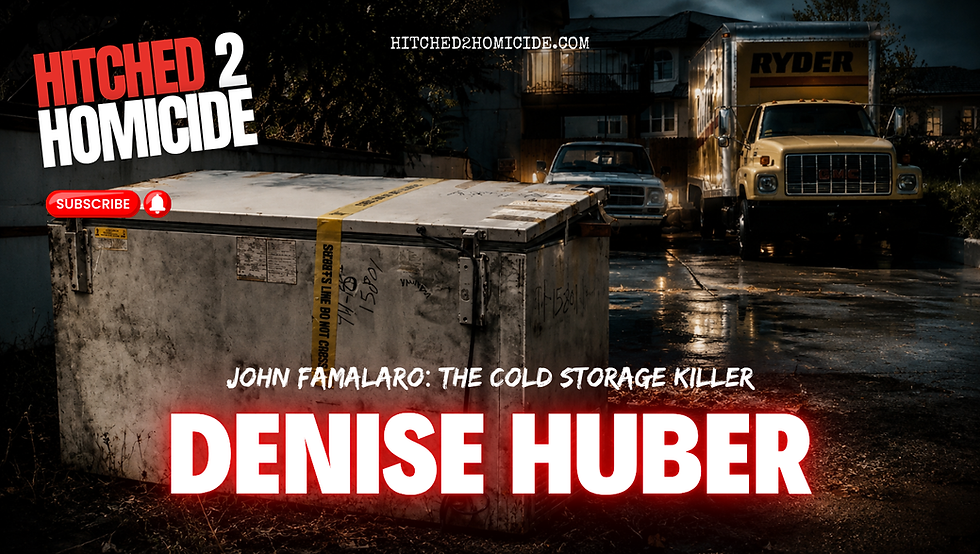
Deputies noticed an extension cord running from the house to a freezer unit inside the parked Ryder truck. When they opened the freezer, they found the nude, handcuffed, frozen remains of a woman. The body had been kept at sub‑zero temperatures for years, preserving not just tissue but evidence of restraint and trauma that would become central at trial.
Fingerprints confirmed the victim as Denise Huber. An autopsy in Maricopa County showed she had died from blunt‑force trauma to the head, having been struck more than 30 times. The medical examiner documented extensive injuries consistent with a prolonged and savage assault, along with evidence of sexual assault. That freezer in an otherwise ordinary neighborhood driveway had, for three years, held the answer to one of Orange County’s most haunting questions: what happened to Denise?
The truck and property were tied to a man named John Joseph Famalaro, a former house painter from Lake Forest who had relocated to Arizona to care for his aging father. Inside the residence and associated storage areas, investigators found women’s clothing, bloodstained items, and weapons, strengthening the connection between Famalaro and Denise’s murder. From a stolen vehicle report emerged not just a homicide victim, but a narrative of a killer who had chosen cold storage as a way to both conceal and preserve his crime.
John Joseph Famalaro: The “Cold Storage Killer”
John Joseph Famalaro was 37 at the time of his arrest and, on paper, not an obvious suspect during the initial missing‑person investigation. He worked as a house painter in Orange County before moving to Prescott, and there was no evidence that Denise knew him or had any prior contact with him. He was not on investigators’ radar in 1991 while her disappearance was actively being investigated.
Famalaro lived in a Laguna Niguel/Laguna Hills warehouse in California before his move; prosecutors later argued this location served as the place where Denise was assaulted and killed. In that warehouse and in his later Arizona home, police found items that suggested a pattern of predatory behavior: women’s clothing, duct tape, restraints, and tools capable of inflicting the kind of blunt‑force trauma documented on Denise’s skull. Some women who had dated him later reported stalking, attempted sexual assaults, and other disturbing behavior, though those accounts did not evolve into additional murder charges.
Experts and media would come to describe him as a sociopathic offender who kept his victim in a freezer as a “trophy,” reinforcing his sense of control and success. Prosecutors echoed that language in court, arguing that the continued refrigeration was both a means of evidence concealment and a psychological signature. The label “Cold Storage Killer” followed from that detail—an offender who not only killed but curated his crime scene over time.
Importantly, Famalaro had no prior felony convictions at the time of his arrest, which complicated early profiling efforts. Yet the combination of stolen property, physical evidence, and the body itself formed a compelling picture of a man who had escalated from troubling behavior to lethal violence, and then sought to control discovery through cold storage and geographic distance.
The Crime: From Freeway Shoulder to Warehouse
During trial, Orange County Deputy District Attorney Christopher Evans reconstructed the likely sequence of events. According to the prosecution, Famalaro encountered Denise after her tire blew out on the freeway shoulder less than three miles from her home. Whether he initially offered help or immediately used force, prosecutors argued that he quickly overpowered her and removed her from the area, preventing her from reaching the nearby call box or convenience store.
The narrative presented in court was stark: Denise was kidnapped, transported to the Laguna Niguel warehouse where Famalaro had been living, bound with duct tape, and sexually assaulted. Evans told the jury that Famalaro sodomized her, then placed three white plastic bags over her head—partly to control bleeding and partly to facilitate the killing. He then struck her in the head at least 31 times with a roofer’s nail puller, a heavy, claw‑like tool capable of crushing bone.
Forensic evidence supported this account: fragments of plastic bags were found embedded in Denise’s skull, along with extensive fractures consistent with repeated blows from a single type of instrument. The number and ferocity of the strikes became a centerpiece of the prosecution’s argument about intent and cruelty, reinforcing the premeditated and sadistic elements of the crime.
Defense counsel tried to mitigate the depiction by suggesting that Denise may have gone to Famalaro’s home willingly, arguing that this could reduce the culpability associated with kidnapping and limit the death penalty exposure. Prosecutors countered that the physical evidence—restraints, bags, the nature and number of the blows—spoke to kidnapping, sexual assault, and deliberate murder. Regardless of the initial contact, the forensic record outlined a sequence that transitioned from opportunity to coercion to lethal violence.
Once Denise was dead, Famalaro placed her body in a freezer, ultimately moving that freezer into the stolen Ryder truck that would later be discovered in Arizona. He kept the freezer powered via an extension cord, maintaining the body’s preservation for three years. That frozen state, chilling in every sense, preserved enough forensic detail to anchor the case even after years of concealment.
Investigation and Forensics: Building the Case
The case against Famalaro was built from several converging strands of evidence, each critical in transforming suspicion into a capital murder prosecution.
Identification of the victim: Fingerprints taken from the frozen remains confirmed that the body in the freezer was Denise Huber.
Cause of death: The autopsy concluded that she died from blunt‑force trauma to the skull, having been struck more than 30 times.
Sexual assault: Medical findings indicated that Denise had been sexually assaulted, consistent with the prosecution’s account of sodomy and prolonged attack.
Physical evidence at Famalaro’s properties: Investigators found women’s clothing, restraints, bloodstained items, and tools in his warehouse and home, tying him to both the assault and the body’s storage.
The stolen truck: The Ryder truck was stolen from Lake Forest and traced to Famalaro, with the freezer and Denise’s body inside, connecting his movement from California to Arizona with ongoing concealment of the victim.
Forensic pathologists detailed the nature and distribution of the skull injuries, explaining to the jury how repeated blows with a nail puller could produce fractures, hemorrhaging, and embedded foreign material. Crime scene analysts linked the plastic bags, tape, and restraints to both the warehouse and the freezer setting, framing the crime as a coherent continuum rather than separate events.
The three‑year gap between the disappearance and discovery meant that early theories about acquaintance‑based homicide had to be revisited in light of new evidence. Investigators eventually acknowledged that Famalaro had not been a suspect during the initial missing‑person search, highlighting how random encounters between predators and vulnerable victims can elude traditional linkage when there is no known relationship. In this sense, the case underscores the difficulty of stranger abduction investigations, particularly when physical evidence at the disappearance site is minimal.
Trial, Conviction, and Death Sentence
In May 1997, after a long‑awaited trial in Orange County Superior Court, a jury convicted John J. Famalaro of first‑degree murder, kidnapping, and sexual assault in the killing of Denise Huber. Jurors took only slightly more than five hours to reach their verdict, a relatively swift decision given the emotional intensity and complexity of the evidence. Famalaro reportedly stared straight ahead and showed little emotion as the verdict was read.
During the penalty phase, the same jury had to decide whether Famalaro should receive life imprisonment without parole or the death penalty. The prosecution emphasized the brutality of the crime, the number of blows, the sexual assault, and the prolonged concealment of the body as aggravating factors. They argued that keeping Denise’s body frozen was not a panicked attempt to dump evidence but an ongoing, deliberate act—a “perverse trophy” preserving his crime.
In September 1997, the jury and court imposed a sentence of death. In 2011, the California Supreme Court upheld that death sentence, rejecting appeals that challenged both the conviction and penalty. Despite California’s evolving stance on executions—largely a de facto moratorium in recent years—Famalaro remains on death row, theoretically awaiting execution.
For Denise’s family, the verdict represented the long‑delayed arrival of accountability. Her father was quoted as saying, “Justice is finally here,” capturing the mixture of relief and enduring grief that often accompanies such outcomes. Yet no sentence could undo three years of not knowing, or the reality of a daughter whose life trajectory was violently erased between a concert and a broken tire.
Legacy of the Case: Fear, Forensics, and Memory
The Denise Huber case resonates in several distinct ways within true crime history and investigative practice.
First, it embodies the terror of roadside vulnerability—what happens when a young woman is stranded alone late at night, even in a well‑lit area. Denise was less than three miles from home, surrounded by infrastructure meant to provide safety (call boxes, a convenience store), yet those safeguards were eclipsed by the presence of a predator. For many listeners and readers, that scenario remains deeply unsettling because it is both mundane and unpredictable.
Second, the case illustrates how forensic evidence can overcome time. The decision to store the body in a freezer, while intended to hide the crime, inadvertently preserved enough physical detail to reconstruct both the cause of death and key elements of the assault. That preservation allowed prosecutors to argue intent and cruelty with unusual specificity, even years later, turning a cold case into a solvable homicide.
Third, the case highlights the limitations of early missing‑person investigations where stranger abduction is involved. With no clear suspects and no body, investigators were left with a disabled car, a timeframe, and theories that leaned toward acquaintances. Only an unrelated property crime—a stolen truck—ultimately broke the case open, reinforcing the importance of cross‑jurisdictional communication and the unpredictable pathways that can suddenly expose a concealed homicide.
Finally, Denise’s story has become part of a larger cultural conversation about safety, violence against women, and the ways predators exploit chance encounters. Documentaries, articles, and episodic true crime coverage continue to revisit the case, framing it as both a cautionary tale and a testament to investigative persistence. For her family, that ongoing attention keeps her memory present, transforming her from an anonymous victim in a freezer to a named, remembered person whose life deserves more space than the horror of its ending.

DISCLAIMER OF LIABILITY
All information contained in this audio podcast or video presentation is provided for entertainment purposes only. The authors leave any and all conclusions to individual members of the audience. The author offers no statements of fact beyond those available through diligent private research or through information freely available in the public record. To the extent that pending or settled criminal matters or crime or possible crimes, are discussed in this audio podcast or video presentation, all parties or defendants are presumed innocent unless proven guilty in a court of law. To the extent that any pending or settled civil matters are discussed in this video presentation, all parties or defendants are presumed not liable unless proven liable in a court of law. Copyright for material incorporated and presented under Fair Use is retained by the original author or copyright holder where applicable. Our cases are researched using open source and archive materials, and the subjects are real crimes and people. We strive to produce each episode with respect to the victims, their families and loved ones. At Hitched 2 Homicide we are committed to always discussing how victims lived, and not just how they died. All podcast information is gleaned from sources given. All opinions in the podcast are solely of Hitched 2 Homicide and are for entertainment purposes only. All suspects are considered innocent until proven guilty in a court of law.
Copyright & OwnershipThis podcast episode, including all audio, video, and written content, is the property of Hitched 2 Homicide and its creators, © 2025 Kris Calvert & Rob Pottorf of RP Music, Inc. All rights reserved.
Do not copy, reproduce, or distribute any part of this content without express written permission.
For licensing, press inquiries, or collaboration requests, contact: kris@hitched2homicide.com
For more true crime episodes, visit: www.Hitched2Homicide.com
Thanks for listening and remember… Southern charm won’t save you from true crime.
THIS PODCAST IS FILMED AT RP STUDIOS, INC.
© 2026 The Calvert Group, LLC FOR HITCHED 2 HOMICIDE
Follow H2H Join H2H In-laws and Outlaws: https://www.facebook.com/groups/h2hinlawsandoutlaws
Instagram: https://www.instagram.com/hitched2homicide/
Twitter: https://twitter.com/H2H_Podcast
Follow and Read Books by Kris Calvert:
Instagram: https://www.instagram.com/kriscalvertauthor/
Facebook: https://www.facebook.com/kriscalvert30
Twitter: https://twitter.com/kriscalvert
Follow and Listen to Music by Rob Pottorf
Instagram: https://www.instagram.com/robpottorfmusic/
Facebook: https://www.facebook.com/RobPottorfMusic
Twitter: https://twitter.com/RobPottorfMusic
Follow Scottie on Instagram 🐶: https://www.instagram.com/scottietotherescue/
On the go? Listen to Hitched 2 Homicide on all major podcast platforms
Apple: https://apple.co/3J0mv1t
Spotify: https://spoti.fi/2T1TU4J
Stitcher: https://bit.ly/H2H_Sticher
Listen on @applepodcasts or watch on @YouTube *link in bio


Comments