Hex Hollow: The Murder of Powwower Nelson Rehmeyer
In late November 1928, a killing in a remote York County, Pennsylvania hollow became one of America’s most notorious intersections of folk belief, fear, sensational journalism, and criminal justice. Nelson D. Rehmeyer—a farmer and practitioner of Pennsylvania German ritual healing commonly called powwowing—was beaten, strangled, and burned inside his home by three people who believed he had cursed them.
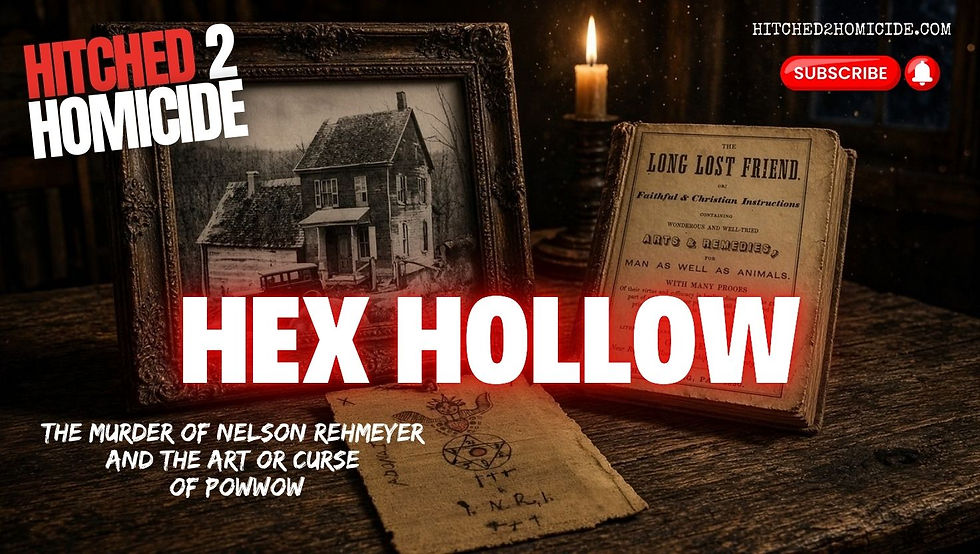
Often reduced to a “witch murder” or ghost-story shorthand, the Hex Hollow case was neither a supernatural event nor a quaint regional oddity. It was a human tragedy: a vulnerable, isolated man was killed after superstition, personal misfortune, and untreated psychological distress were turned into a deadly accusation. The subsequent 1929 trials drew national and international press attention and permanently attached the name “Hex Hollow” to Rehmeyer’s home valley.ydr+1
The place called Hex Hollow
The crime occurred in Rehmeyer’s Hollow, a secluded rural valley in southern York County, Pennsylvania, near Winterstown and Stewartstown. The hollow had long been associated with the Rehmeyer family, who began settling there in the nineteenth century. In the decades after the murder, its popular nickname—Hex Hollow—came to eclipse its family name in public memory.
In 1928, the hollow’s physical isolation mattered. Nelson Rehmeyer lived alone in a rural farmhouse, estranged from his wife, Alice, and separated from the ordinary safeguards of a closely watched town neighborhood. When violence came to his door at night, there was no nearby crowd, police officer, or family member immediately able to intervene. Rehmeyer’s animals going unfed helped alert neighbors that something was wrong after the attack.
“They went looking for a curse—and found someone to blame.”
The place has since become inseparable from the story. The surviving house is widely known as the Hex House or Hex Murder House, and it became a focal point for local history, paranormal folklore, and dark-tourism interest. Yet the name risks transforming a murder scene into a prop. At its center, it was the home of a man who was killed there.
Nelson Rehmeyer and powwowing
Nelson Rehmeyer was not simply “a witch,” despite the language used in many early headlines and later retellings. He was associated with a Pennsylvania German folk-healing tradition commonly known as powwowing—also called Braucherei. The tradition combined spoken prayers, Bible verses, charms, household remedies, and ritual practices intended to treat illness, protect people and animals, stop bleeding, counter misfortune, and restore well-being. It formed part of a much larger Pennsylvania German cultural and religious landscape.
The word “powwow” is historically loaded and can be misleading. In the Pennsylvania German context, it refers to a tradition of ritual healing—not to the Indigenous ceremonial meaning of the word. Many practitioners understood their work as Christian, protective, and therapeutic rather than as malicious “witchcraft.” The Pennsylvania German Cultural Heritage Center and Glencairn Museum describe powwowing as a centuries-old regional folk-healing system blending belief, religion, and healing practices.
Rehmeyer was reportedly regarded by some local people as a powwower or healer. That reputation could make him someone to consult during sickness or misfortune—but it could also make him vulnerable to suspicion. In communities where curses were believed possible, a person thought capable of lifting trouble might also be imagined capable of causing it.
That distinction is fundamental to understanding the case:
Popular myth | Historical context |
Rehmeyer was a “witch” killed for practicing dark magic | Rehmeyer was associated with powwowing, a Pennsylvania German folk-healing tradition |
Powwowing was necessarily about hexing people | Its practices included prayers, protective charms, remedies, and healing rituals |
The murder proved a supernatural curse was at work | The murder resulted from human belief, fear, coercion, and violence |
The Long Lost Friend was a simple “spell book” | It was a widely circulated compendium of folk remedies, charms, prayers, and practical material in the Pennsylvania German tradition |
The book most associated with the case was Johann Georg Hohman’s Der lange verborgene Freund, usually known in English as The Long Lost Friend or The Long Hidden Friend. First published in German in Pennsylvania in 1820, it gathered folk remedies and magical-religious material with roots in older European traditions. It remained deeply influential among Pennsylvania German communities and was repeatedly printed in German and English.
Although later accounts frequently call it a “book of spells,” the phrase should be used carefully. The book’s contents included charms and incantations, but also practical household, agricultural, and medical advice. In other words, it occupied a historical space where religion, vernacular medicine, protection, and folk belief overlapped—far more complicated than the modern horror-movie category of a sinister grimoire.
John Blymire’s fear
The central figure behind the murder was John Blymire, a man about 30 years old in 1928. His life had been marked by personal hardship: unstable employment, family loss, and a persistent belief that hostile forces were working against him. Contemporary and later reporting described a man increasingly consumed by the idea that he had been hexed.
Blymire had known Rehmeyer and had reportedly worked for him. Instead of seeing his troubles as the result of grief, poverty, illness, circumstance, or mental distress, he came to interpret them as evidence of a supernatural attack. He sought help from a woman in the Marietta area of Lancaster County—often identified in later retellings as Nellie Noll or Emma Knopp—who allegedly named Rehmeyer as the person responsible for Blymire’s bad luck.
The alleged remedy was specific. Blymire was told that he needed items connected to Rehmeyer, especially a lock of his hair and his copy of The Long Lost Friend. Accounts differ in minor details about exactly how these objects were to be disposed of, including whether they were to be buried at a particular depth and whether the book was to be burned. But the basic point remains consistent: Blymire believed possession and destruction of these objects would break the curse.
That belief transformed Rehmeyer from a folk healer—or, at minimum, a man with a local reputation for folk healing—into a perceived source of danger. It gave Blymire a target, a mission, and a framework that made escalating violence appear, to him, like self-defense.
The night of the murder
On the night of November 27, 1928, Blymire went to Rehmeyer’s house with two younger companions: Wilbert Hess, 18, and John Curry, only 14. Hess reportedly believed that his own family’s troubles and failing farm were connected to a hex. Curry, still a child by modern standards, became involved in an event whose consequences would shape the rest of his life.
The group’s immediate objective was to obtain the objects they believed could undo the alleged curse. They demanded Rehmeyer’s copy of The Long Lost Friend and sought a lock of his hair. Rehmeyer refused to cooperate.
What followed was not a ritual, an exorcism, or an act of supernatural defense. It was a home invasion and murder.
During the struggle, Rehmeyer was beaten, restrained, and killed. Reports describe the assailants using violence that included bludgeoning and strangulation. They then placed a mattress over his body, poured burning lantern oil over it, and set the house on fire in an apparent attempt to destroy evidence. The fire did not consume the house as they intended.
Rehmeyer’s body was discovered on Thanksgiving Day, November 29, after neighbors noticed that his animals had not been fed. He left behind his estranged wife and two children. He was buried in Sadler’s Church Cemetery.
The fact that the house survived the fire became part of the legend. To believers in the supernatural, it could be treated as proof of Rehmeyer’s extraordinary power. Historically, however, it is evidence of nothing more mystical than an unsuccessful attempt to conceal a violent crime.
Arrests, trial, and verdicts
The investigation moved quickly. Rehmeyer’s wife reportedly told authorities that Blymire and Curry had come to her seeking directions to Rehmeyer’s isolated home. That lead helped focus suspicion on the group. Detectives arrested Blymire, Curry, and Hess, and the defendants’ own statements laid bare the logic behind the crime: they believed Rehmeyer had hexed them and that obtaining his hair and book would free them.
Their January 1929 trials became a media sensation. Reporters descended on York County, portraying the proceedings as a modern echo of the Salem witch trials. That framing generated headlines and public fascination, but it also flattened the people and culture involved. Rural Pennsylvanians were often portrayed as ignorant believers in primitive superstition, while the nuances of Pennsylvania German folk practice were reduced to lurid tales of witches and spells.
The prosecution treated the case as what it was: murder. Belief in a curse did not erase criminal responsibility.
Defendant | Age in 1928 | Reported role | Verdict and sentence |
John Blymire | About 30 | Organizer and principal believer that Rehmeyer had hexed him | First-degree murder; life imprisonment |
John Curry | 14 | Accompanied Blymire and Hess in the attack | First-degree murder; life imprisonment |
Wilbert Hess | 18 | Joined the group and believed his family’s troubles were caused by a hex | Second-degree murder; prison sentence reported as 10 to 20 years in trial accounts |
The trial record is sometimes summarized inconsistently in popular accounts, especially regarding Hess’s sentence and the claim that all three men received life terms. Contemporary-derived summaries and detailed reconstructions generally distinguish Hess’s second-degree conviction from the first-degree convictions of Blymire and Curry.
All three defendants were eventually released. Blymire left prison in 1953 after repeated appeals and later lived in Philadelphia, where he worked as an apartment-house manager until his death in 1977. Curry served approximately 10 years, later joined the U.S. Army, worked as a cartographer connected with Gen. Dwight D. Eisenhower’s staff during World War II, and became an artist. Hess served his sentence, returned to York County, and worked as an electroplater.
Their later lives do not diminish the crime, but they complicate any simplistic attempt to turn the case into a story of permanent villains and innocent bystanders. Curry was 14 at the time of the murder. Blymire appears to have been deeply unwell and desperate. Hess was a young man caught in the same world of fear and misfortune. None of that excuses their actions. It does, however, show why the case should be understood as a catastrophe with multiple human failures—not a supernatural morality play.
Why the Hex Hollow murder matters
The Hex Hollow murder endures because it sits at the intersection of several powerful American stories:
The persistence of folk belief in an age often assumed to have become modern and rational
The vulnerability of socially isolated people who are marked as unusual, feared, or misunderstood
The danger of interpreting illness, loss, economic hardship, and emotional suffering as evidence of malicious supernatural attack
The media’s tendency to sensationalize rural communities and unfamiliar religious or cultural practices
The gap between a person’s cultural reputation and the reality of who they were
Rehmeyer’s death was not caused by folk healing itself. It was caused by an accusation that converted another person’s suffering into a justification for violence. The distinction matters. Powwowing was practiced by people who sought relief from illness, pain, fear, and uncertainty. The murderers distorted the language of that tradition into a rationale for invading a man’s home and killing him.
The case also invites a more compassionate reading of Blymire’s role without romanticizing it. Accounts of his repeated searches for people who could “cast the demons out of his head,” coupled with his fixation on persecution and curses, suggest profound distress. Modern readers should be cautious about diagnosing a historical person from a distance. Still, the story plainly raises questions about what might have happened if someone in Blymire’s world had recognized his fears as a crisis requiring care rather than confirming them as proof of witchcraft.
For York County, the murder became an enduring symbol. It inspired books, local-history programs, articles, documentaries, ghost stories, and visits to the former Rehmeyer home. J. Ross McGinnis’s Trials of Hex is frequently identified by York County historians as a leading detailed account of the crime and trials; the case has also been explored in Shane Free’s documentary Hex Hollow: Witchcraft and Murder in Pennsylvania.
Separating history from legend
Because the Hex Hollow murder has been retold for almost a century, its history has accumulated exaggerations. A responsible account should distinguish the well-supported facts from the folklore built around them.
Well established
Nelson Rehmeyer was killed in his York County home in late November 1928.
John Blymire, John Curry, and Wilbert Hess participated in the crime.
The men believed Rehmeyer had placed a hex on Blymire and, in Hess’s case, possibly on his family.
They sought Rehmeyer’s hair and his copy of The Long Lost Friend as a means of breaking the alleged curse.
Rehmeyer was beaten, killed, and his body and home were set on fire.
The three men were arrested, tried, convicted, and imprisoned.
The trial became a major national and international news story.ydr+2
Often exaggerated or misleading
Calling Rehmeyer a “witch” as if that fully describes his identity or practices
Treating powwowing as equivalent to evil magic or deliberate curse-casting
Repeating every variation of the alleged anti-hex ritual as settled fact
Suggesting the surviving house or incomplete fire establishes paranormal activity
Framing the case as a quaint, remote survival of medieval superstition rather than a lethal event involving poverty, grief, fear, cultural misunderstanding, and violence
The longer historical lesson is uncomfortable: people do not need to believe in literal witchcraft to make scapegoats. Whenever misfortune becomes attached to a person, a group, a religion, an ethnicity, or a perceived outsider, fear can make violence feel justified. Hex Hollow is therefore not only a Pennsylvania story. It is a cautionary American story about blame.
Legacy of Nelson Rehmeyer
Nelson Rehmeyer’s name is often subordinated to the phrase “Hex Hollow,” as though the crime scene matters more than the victim. A better telling restores him to the center.
He was a farmer, a husband and father, and a man associated with a regional healing tradition. He may have been eccentric, solitary, or controversial in his community. None of those traits made him responsible for the misfortunes of John Blymire or Wilbert Hess. None made him a threat. And none justified what happened in his home on November 27, 1928.
The legacy of Hex Hollow should not be a celebration of the supposedly supernatural. It should be a reminder of the real-world consequences of fear when it is reinforced rather than challenged. Nelson Rehmeyer was not killed by a hex. He was killed by people who believed one existed.

Sources used for this podcast:
Aurand, A. M., Jr. (1929). An account of the “witch” murder trial, York, Pa., January 7–9, 1929: Commonwealth of Pennsylvania v. John Blymyer, et al. HathiTrust Digital Library. https://catalog.hathitrust.org/Record/006811748
Commonwealth v. Curry, 298 Pa. 363 (Pa. 1930). https://law.justia.com/cases/pennsylvania/supreme-court/1930/298-pa-363.html
Evening Star. (1929, January 9). Blymyer was below average intelligence and a borderline case between feeble-mindedness and definite insanity [Newspaper page]. Library of Congress. https://www.loc.gov/resource/sn83045462/1929-01-09/ed-1/
Fear of witchcraft leads to murder; “Pow-wow doctor” and two youths held in slaying of Pennsylvania farmer. (1928, December 1). The New York Times. https://www.nytimes.com/1928/12/01/archives/fear-of-witchcraft-leads-to-murder-powwow-doctor-and-two-youths.html
Farmers fleeced through “black art”; “powwow doctors” trade on belief of rural folk. (1928, December 3). The New York Times. https://www.nytimes.com/1928/12/03/archives/farmers-fleeced-through-blackart-powwow-doctors-trade-on-belief-of.html
Prisoner told him, “I got the witch”; third witness at York, Pa., trial tells of Blymyer statement. (1929, January 8). The New York Times. https://www.nytimes.com/1929/01/08/archives/prisoner-told-him-i-got-the-witch-third-witness-at-york-pa-trial.html
Bars witchcraft as murder defense; judge rules that “delusions” of “powwow doctor” do not constitute legal insanity. (1929, January 9). The New York Times. https://www.nytimes.com/1929/01/09/archives/bars-witchcraft-as-murder-defense-judge-rules-that-delusions-of.html
“Witch” killer guilty, sentenced for life; York, Pa., jury convicts John H. Blymyer. (1929, January 10). The New York Times. https://www.nytimes.com/1929/01/10/archives/witch-killer-guilty-sentenced-for-life-york-pa-jury-convicts.html
Boy denies joining in “witch killing”; John Curry, on witness stand, says he held “hex doctor” while Blymyer beat him. (1929, January 11). The New York Times. https://www.nytimes.com/1929/01/11/archives/boy-denies-joining-in-witch-killing-john-curry-on-witness-stand.html
Convicts boy of 14 for “witch” murder; York, Pa., jury fixes penalty of life in prison for Curry. (1929, January 12). The New York Times. https://www.nytimes.com/1929/01/12/archives/convicts-boy-of-14-for-witch-murder-york-pa-jury-fixes-penalty-of.html
Third witch killer convicted at York; Wilbert Hess, 18, was member of family believed to be under victim’s “hex.” (1929, January 13). The New York Times. https://www.nytimes.com/1929/01/13/archives/third-witch-killer-convicted-at-york-wilbert-hess-18-was-member-of.html
Intelligencer Journal. (1928, December 1). Emma Knopp admits giving Yorker advice and later denies [Newspaper clipping]. Newspapers.com. https://www.newspapers.com/article/intelligencer-journal-emma-knopp-blymi/74579284/
News and Farmer. (1929, January 10). Judge Sherwood’s ruling in the Blymyer murder trial [Newspaper page]. Georgia Historic Newspapers. https://gahistoricnewspapers.galileo.usg.edu/lccn/sn86053065/1929-01-10/ed-1/seq-1/ocr/
Philadelphia Inquirer. (1928, December 2). Coverage of the Rehmeyer murder and investigation.Note: Consult the original newspaper page rather than a secondary quotation of it; it is cited as a resource within Uncharted Lancaster’s article.unchartedlancaster
Books and historical texts
Hohman, J. G. (1820). Der lange verborgene Freund [The long lost friend]. Harrisburg, PA. https://archive.org/details/0223252.nlm.nih.gov
Hohman, J. G. (1850). The long lost friend, or, Faithful & Christian instructions containing many excellent and approved remedies for man and beast. Harrisburg, PA. https://archive.org/details/0223252.nlm.nih.gov
McGinnis, J. R. (2000). Trials of hex: A study of the Hex Murder and the trials of John Blymire, John Curry, and Wilbert Hess. York, PA: Author/Stock and Leader.Note: This is the leading book-length historical account. Verify publisher and edition details from the title page of the copy you use.
Lewis, A. H. (1969). Hex. New York, NY: Trident Press. https://books.google.com/books/about/Hex.html?id=EpJ-AAAAMAAJ
York County history and local reporting
McClure, J. (2007, June 8). “Trials of Hex” helps make sense of notorious York County murder case. York Town Square / York Daily Record. https://yorkblog.com/yorktownsquare/trials-of-hex-makes-sense-of-n/
McClure, J. (2007, November 5). Visiting the scene of (York County’s hex) crime. York Town Square / York Daily Record. https://yorkblog.com/yorktownsquare/mcginnis-and-hex-1/
McClure, J. (2007, December 27). Noted York family—the Cohens—produced Pa. Supreme Court justice. York Town Square / York Daily Record. https://www.ydr.com/story/news/history/blogs/york-town-square/2007/12/27/cohen-etc/31565505/
McClure, J. (2009, December 6). What happened to Hex Murder defendants, convicted in York County 80 years ago? Part I. York Town Square / York Daily Record. https://yorkblog.com/yorktownsquare/hex-murder-rehmayer/
McClure, J. (2009, December 7). What happened to Hex Murder defendants, convicted in York County 80 years ago? Part II. York Town Square / York Daily Record. https://yorkblog.com/yorktownsquare/hex-murder-defendants/
McClure, J. (2012, October 8). York County’s Hex Murder: Five quick facts about the forever-fascinating witchcraft case. York Town Square / York Daily Record. https://yorkblog.com/yorktownsquare/york-countys-hex-murder-5-quick-facts-about-the-forever-fascinating-witchcraft-case/
McClure, J. (2013, February 6). Hex Murder assailant: “A genuinely nice guy and was a good employee.” York Town Square / York Daily Record. https://www.ydr.com/story/news/history/blogs/york-town-square/2013/02/06/hex-murder-assailant-a-genuinely-nice-guy-and-was-a-good-employee/31682497/
McClure, J. (2013, October 28). Hex Murder defendant John Curry’s artwork hangs in York County homes. York Town Square / York Daily Record. https://www.ydr.com/story/news/history/blogs/york-town-square/2013/10/28/hex-murder-defendant-john-currys-artwork-hangs-in-york-county-homes/31560479/
McClure, J. (2017, October 14). Murder and witchcraft: The incredible story of York County’s Hex Murder. York Daily Record. https://www.ydr.com/story/news/history/blogs/york-town-square/2017/10/14/murder-and-witchcraft-incredible-story-york-countys-hex-murder/764018001/
York County Archives. (n.d.). Records. https://archives.yorkcountypa.gov/records/
York County History Center. (n.d.). Publications. https://www.yorkhistorycenter.org/research/publications/
Powwowing, Braucherei, and Pennsylvania German context
Berks History Center. (2023, December 4). The origin and practice of pow-wow among the Pennsylvania Germans. https://berkshistory.org/article/the-origin-and-practition-of-pow-wow-among-the-pennsylvania-germansthe-origin-and-practition-of-pow-wow/
Donmoyer, P. (2019). Pennsylvania Dutch powwowing [Video recording]. Kutztown University Libraries, Pennsylvania German Cultural Heritage Center. https://research.library.kutztown.edu/pagermandutch_kutztownfolkfestival_peformers/3/
Glencairn Museum. (2017, March 2). Powwowing in Pennsylvania: Healing rituals of the Pennsylvania Dutch. https://www.glencairnmuseum.org/newsletter/2017/3/2/powwowing-in-pennsylvania
Pennsylvania German Cultural Heritage Center. (2025). Powwowing in Pennsylvania [Exhibition catalogue]. https://www.pagerman.org/wp-content/uploads/2025/07/Powwowing-In-Pennsylvania-PGCHC-Schwenkfelder-Exhibition-Catalogue-2025-Revision.pdf
Pennsylvania German Cultural Heritage Center. (n.d.). Pennsylvania German Cultural Heritage Center. https://www.pagerman.org/
University Press Library Open. (2025). The long lost friend. https://uplopen.com/books/m/10.1515/9780271101194
National Geographic. (2026, March 8). A new generation is bringing Pennsylvania Dutch folk magic back to life. https://www.nationalgeographic.com/culture/article/pennsylvania-dutch-folk-magic-braucherei
Emma Knopp / “Nellie Noll” and Marietta materials
PennLive. (2023, October 6). Fear of folk magic led to murder in central Pennsylvania’s Hex Hollow. https://www.pennlive.com/life/2023/10/folk-magic-led-to-murder-in-hex-hollow-paranormal-pa.html
Ries, T. (2019, August 27). The River Witch of Marietta and the curse of Hex Hollow. The Marietta Traveler. https://www.themariettatraveler.com/2019/08/27/the-river-witch-of-marietta-and-the-curse-of-hex-hollow/
Uncharted Lancaster. (2022, November 23). Witchcraft and murder in Hex Hollow. https://unchartedlancaster.com/2022/11/23/the-river-witch-curse-of-hex-hollow/
Find a Grave. (n.d.). Emma Atlee Knopp (1855–1933) memorial. https://www.findagrave.com/memorial/247879867/emma-knopp
Documentary, visual, and supplemental sources
Free, S. (Director). (2015). Hex Hollow: Witchcraft and murder in Pennsylvania [Documentary film].A useful interview-driven documentary, particularly for family recollections; verify all factual claims against trial records and contemporary newspapers.
Etsy seller listing. (n.d.). Long lost friend—Pow Wow—by John George Hohman [Digital reproduction listing]. Etsy. https://www.etsy.com/listing/1464062407/long-lost-friend-pow-wow-by-john-georgeUse only to document the modern sale or circulation of a reproduction—not as a source for the original text, its publication history, or the Hex Hollow case.etsy
Facebook. (n.d.). Historic image related to the Hex Hollow / Rehmeyer case [Photograph]. https://www.facebook.com/photo/?fbid=953312977795135&set=pcb.27904485329210947
Aguirre-Sacasa, R., & Hedtke, C. (Writers), & Seidenglanz, R. (Director). (2019, April 5). Chapter twenty: The Mephisto waltz [TV series episode]. In R. Aguirre-Sacasa, G. Berlanti, S. Schechter, J. Goldwater, & L. T. Krieger (Executive Producers), Chilling adventures of Sabrina. Berlanti Productions; Warner Bros. Television.
Hand, D. (Director). (1937). Snow White and the seven dwarfs [Film]. Walt Disney Productions.
Hitchcock, A. (Director). (1960). Psycho [Film]. Shamley Productions.
Konner, J., & Waters, D. (Directors). (2011). Drunk History Christmas: Featuring Ryan Gosling, Jim Carrey, and Eva Mendes [Short film]. Funny or Die.
Lord, P., & Miller, C. (Directors). (2014). The LEGO movie [Film]. Warner Animation Group; Village Roadshow Pictures; RatPac-Dune Entertainment; Vertigo Entertainment; Lin Pictures; The LEGO Group; Animal Logic.
Oz, F. (Director). (1986). Little shop of horrors [Film]. The Geffen Company.
Zemeckis, R. (Director). (1994). Forrest Gump [Film]. Paramount Pictures; The Steve Tisch Company; Wendy Finerman
Follow H2H Join H2H In-laws and Outlaws: https://www.facebook.com/groups/h2hinlawsandoutlaws
Instagram: https://www.instagram.com/hitched2homicide/
Twitter: https://twitter.com/H2H_Podcast
Follow and Read Books by Kris Calvert:
Instagram: https://www.instagram.com/kriscalvertauthor/
Facebook: https://www.facebook.com/kriscalvert30
Twitter: https://twitter.com/kriscalvert
Follow and Listen to Music by Rob Pottorf
Instagram: https://www.instagram.com/robpottorfmusic/
Facebook: https://www.facebook.com/RobPottorfMusic
Twitter: https://twitter.com/RobPottorfMusic
Follow Scottie on Instagram 🐶: https://www.instagram.com/scottietotherescue/
On the go? Listen to Hitched 2 Homicide on all major podcast platforms
Apple: https://apple.co/3J0mv1t
Spotify: https://spoti.fi/2T1TU4J
Google: https://bit.ly/H2H_Podcast
Amazon: https://amzn.to/3NMFm2y
Stitcher: https://bit.ly/H2H_Sticher
Pandora: https://bit.ly/H2H_Pandora
iHeart Radio: https://ihr.fm/2ySzLah
Tune in Alexa: https://bit.ly/Alexa_H2H
Listen on @applepodcasts or watch on @YouTube https://www.youtube.com/@hitched2homicidepodcast
DISCLAIMER OF LIABILITY
All information contained in this audio podcast or video presentation is provided for entertainment purposes only. The authors leave any and all conclusions to individual members of the audience. The author offers no statements of fact beyond those available through diligent private research or through information freely available in the public record. To the extent that pending or settled criminal matters or crime or possible crimes, are discussed in this audio podcast or video presentation, all parties or defendants are presumed innocent unless proven guilty in a court of law. To the extent that any pending or settled civil matters are discussed in this video presentation, all parties or defendants are presumed not liable unless proven liable in a court of law. Copyright for material incorporated and presented under Fair Use is retained by the original author or copyright holder where applicable. Our cases are researched using open source and archive materials, and the subjects are real crimes and people. We strive to produce each episode with respect to the victims, their families and loved ones. At Hitched 2 Homicide we are committed to always discussing how victims lived, and not just how they died. All podcast information is gleaned from sources given. All opinions in the podcast are solely of Hitched 2 Homicide and are for entertainment purposes only. All suspects are considered innocent until proven guilty in a court of law.
Copyright & OwnershipThis podcast episode, including all audio, video, and written content, is the property of Hitched 2 Homicide and its creators, © 2026 Kris Calvert & Rob Pottorf of RP Music, Inc. All rights reserved.
Do not copy, reproduce, or distribute any part of this content without express written permission.For licensing, press inquiries, or collaboration requests, contact: kris@hitched2homicide.comFor more true crime episodes, visit: www.Hitched2Homicide.com Thanks for listening and remember… Southern charm won’t save you from true crime.
THIS PODCAST IS FILMED AT RP STUDIOS, INC.© 2025 RP MUSIC, INC. FOR HITCHED 2 HOMICIDE


Comments